Restricted Joints
A segment that is not moving or sharing load the way it should. You may feel it as stiffness, but the fixation is what drives the compensation in the joints around it.
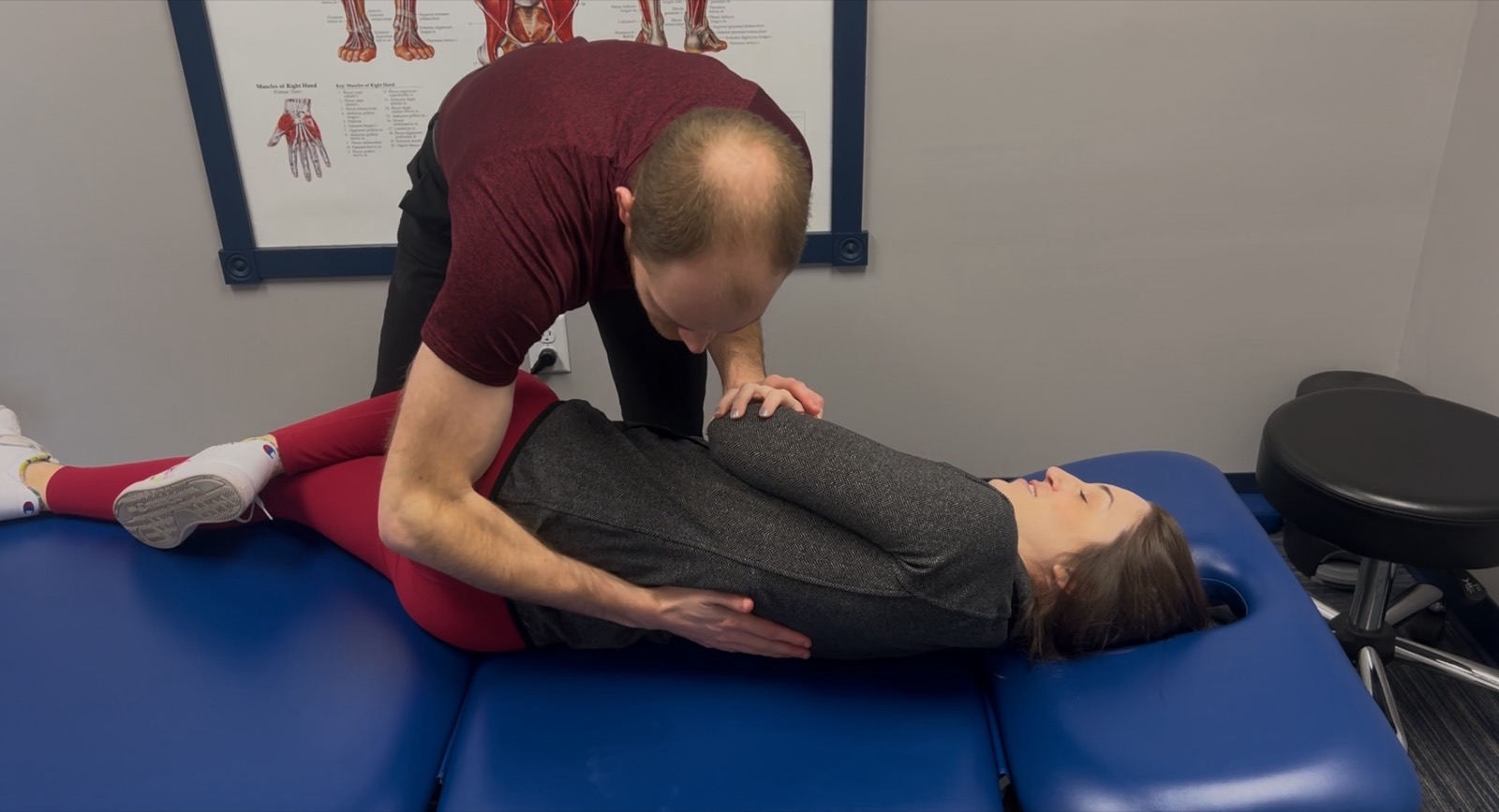
We assess what is moving and adjust what is stuck. No re-aligning, just restoring the movement a segment has lost, and knowing exactly which segment that is.
A segment that is not moving or sharing load the way it should. You may feel it as stiffness, but the fixation is what drives the compensation in the joints around it.
The body recruits around fixated segments. That means the neighboring joints absorb extra stress with every rep, stride, and position change. Restoring motion there changes the load picture immediately.
An adjustment creates a mechanical opening. Functional rehab is what teaches your body to use that opening so the change holds when you leave the clinic.
Before anything is adjusted, every spinal segment gets moved through its full range. A healthy joint has give at the end. A fixated joint hits a hard stop. That distinction, felt during movement, tells us which segment to adjust and in which direction. That is the method taught by Motion Palpation Institute.
Fixated segments cannot absorb their share of force, so the surrounding areas compensate. That is often where the pain shows up, which is why adjusting based on pain location alone tends to miss.
The spine alternates between regions built for stability and regions built for mobility. At the transitions between those roles, the body defaults to stiffness. There is no clean handoff protocol. Stiffness at the junction is mechanically safer for the body, but it shifts load onto the segments above and below, and that is where symptoms accumulate.
The transition between the neck and the upper back. When this segment stiffens, the cervical spine above it is forced to compensate. Symptoms land as upper trap tension, a nagging ache along the inner edge of the shoulder blade, or headaches that keep cycling back, not at C7 to T1 where the fixation sits. The fixation sits at the junction. The symptoms show up somewhere else.
The transition between the thoracic and lumbar spine. The thoracic spine is built for rotation. The lumbar spine is not. When T12 to L1 fixates, the lumbar segments below absorb the rotational load the thoracic spine should be handling. Golfers, baseball players, hockey players, and anyone whose sport or work involves repeated twisting tend to accumulate stress here.
Where the lumbar spine meets the sacrum, and the most common site of disc pathology, nerve root involvement, and facet irritation. When this junction fixates, the lumbar levels above and the sacroiliac joint below both compensate. The clinical picture is usually mixed: low back tightness, hip restriction, and referred symptoms that shift depending on recent activity.
The sound that sometimes accompanies an adjustment is cavitation: gas releasing from the joint capsule as pressure inside changes. It is not bone cracking. Nothing is breaking, and nothing is being moved back into place. The adjustment restores joint play: the small, healthy movement that a fixated segment has lost. Whether or not you hear the pop, that is what happened.
Some people expect the sound and feel better when they hear it. Others find it uncomfortable. Either way, it is not a measure of whether the adjustment worked. If you prefer to avoid cavitation-based techniques, instrument-assisted methods and lower-force mobilization are available. The goal is effective treatment, not a particular sound.
Functional rehab is the foundation here. An adjustment restores motion to a fixated segment. That solves a real problem, but only part of it: once the joint moves, your nervous system still has to learn to stabilize it under load. Skip that, and the same pattern that drove the fixation locks it up again.
That is where the rehab comes in. The exam finds the segment, the adjustment opens the mechanical window, and the rehab that follows retrains the stabilizing system so the better position holds when you get back to the load that broke it down. Soft tissue work and dry needling layer in the same way, each used where the exam calls for it.